Free DESIGN | Send a Request >>>
Free DESIGN | Send a Request >>>

The CMYK color model, sometimes referred to as Euroscale, is the industry standard for professional offset and digital printing. Whether you are producing custom paper bags, catalogs, brochures or cardboard packaging, preparing your artwork in CMYK is essential for accurate and consistent color reproduction.
In this article, you will learn how CMYK printing works, what its main advantages are, when it is the best choice and how it differs from RGB, Pantone and HKS.
CMYK is a subtractive color model used to reproduce color images and graphics in professional printing. Its name comes from the four process inks used during production:
By combining these four inks in different percentages, millions of colors can be reproduced. This makes the CMYK process the standard solution for printed marketing materials, packaging, catalogs, magazines and custom paper bags.
Unlike RGB, which creates colors using light on digital displays, CMYK reproduces colors by applying ink to paper and other printable materials.
CMYK printing uses a subtractive color process. Instead of creating colors with light, as RGB does, it works by absorbing portions of the light reflected from the white surface of the paper.
Each process ink absorbs a different part of the visible spectrum:
During printing, the inks are applied in different percentages using tiny halftone dots. When viewed from a normal distance, these dots visually blend together, allowing the eye to perceive continuous colors and smooth gradients.
Although cyan, magenta and yellow theoretically create black when combined, the result is usually a dark brown or gray tone. For this reason, a separate black ink (K) is added to achieve:
The CMYK process reproduces smooth gradients and a wide range of tones, making it the preferred choice for catalogs, magazines, brochures and printed products containing photographs.
Designs containing many different colors can be reproduced efficiently using only four process inks, eliminating the need for a separate ink for every individual color.
Modern offset and digital printing companies worldwide rely on CMYK printing, allowing artwork to be reproduced consistently across different presses and production facilities.
CMYK is commonly used for:
RGB and CMYK were developed for different purposes.
RGB is designed for digital devices such as computer monitors, smartphones and televisions. Because it uses light, RGB can display brighter and more saturated colors than can be reproduced with printing inks.
The CMYK workflow, on the other hand, was developed specifically for professional printing. Since its printable color gamut is smaller than RGB, certain vivid RGB colors may appear less saturated after conversion.
If a design is intended for print, it is always recommended to prepare and proof the artwork directly in CMYK rather than converting it at the final stage.
CMYK printing is the preferred solution for custom paper bags when the design includes:
Using only four process inks, full-color printing can reproduce detailed, high-quality images while remaining a cost-effective production method.

Choosing the right color system depends on the design, the printed product and the required level of color accuracy.
CMYK is the best choice for photographs, gradients and multicolor artwork.
When corporate colors must be reproduced with maximum consistency across different print runs, spot colors are usually the better solution.
The most widely recognized spot color system worldwide is the Pantone Matching System (PMS). Learn more in our article "Pantone Color System – How It Works and Why It Matters."
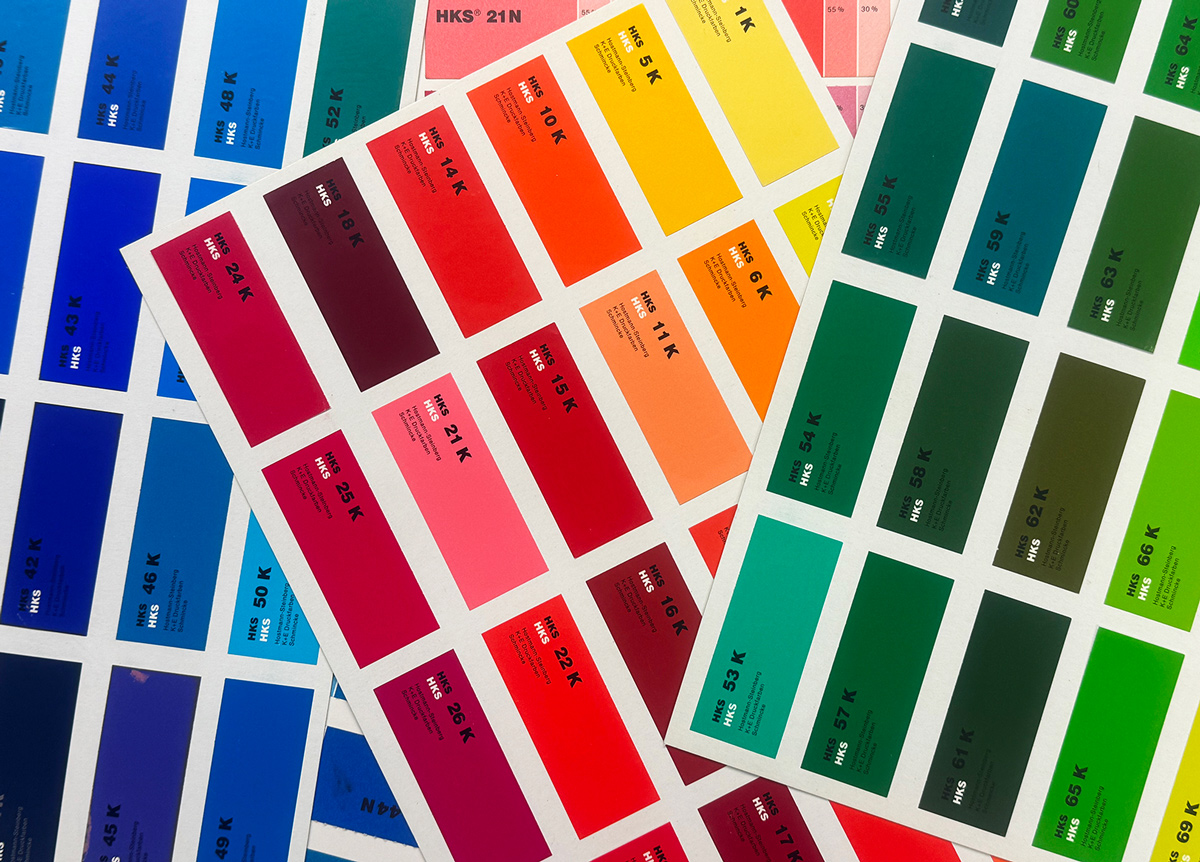
The HKS Color System is another popular spot color standard, especially in Germany and several European countries. Read more in our article "HKS Color System – How It Works and Why It Matters."
Many commercial printing projects combine both approaches—CMYK printing is used for photographs and detailed graphics, while Pantone or HKS is selected for logos and corporate colors requiring maximum precision.
To achieve the best possible print quality:
Following these recommendations significantly reduces the risk of unexpected differences between the design displayed on screen and the final printed product.
The CMYK color model combines excellent print quality, reliable color reproduction and cost-effective production. By using only four process inks, process color printing can reproduce millions of color combinations while delivering sharp text, smooth gradients and high-quality photographs.
Whether you are producing promotional paper bags, catalogs, brochures or packaging, preparing artwork correctly for CMYK printing remains one of the most important steps toward achieving professional printing results.
To learn more about professional color management and printing standards, visit the official websites of:
Learn More About Color Systems in Offset Printing: